Clickbait Thumbnails: Where YouTube Draws the Line (2026)
By Aymane Senhaji, Founder, ThumbnailMaker · · 8 min read
Quick answer: a clickbait thumbnail is one that promises something the video does not deliver. That is YouTube's definition, not a matter of taste: its thumbnail policy bans "a thumbnail that misleads viewers to think they're about to view something that's not in the video", and its spam policy lists "malicious clickbait" as a reason to suspend monetisation or strike a channel. Short of a policy case, YouTube spots clickbait with two numbers: a high click-through rate next to a low average view duration, with fewer impressions than expected afterwards, which is how its CTR FAQ describes it. A bold thumbnail is not the problem. A shocked face, huge text and a wild claim are fine when the video keeps the promise. The line is kept or broken in the video, and YouTube measures it in watch time.
What is a clickbait thumbnail on YouTube?
On YouTube, clickbait means a title or thumbnail that promises something the video does not deliver, and a clickbait thumbnail makes that promise with the image. The promise can be an image (a car on fire when no car burns), a number ("$100,000" when the giveaway was $100), a word ("EXPOSED", "GONE WRONG") or an expression (a shocked face over a video where nothing surprising happens). The click happens because the viewer believes the promise; the regret comes early in the video; the leave is what YouTube records.
The word gets used loosely for any loud thumbnail, which is why the question "is this clickbait?" needs YouTube's definition and not a feeling. Loud is a style. Clickbait is a mismatch. A thumbnail of a man screaming "I FOUND THE RAREST DIAMOND" on a video where he finds the rarest diamond is loud and honest. The same thumbnail on a video where he finds iron is clickbait, and a quieter version of the same lie would still be.
How does YouTube detect clickbait?
With the two numbers every creator can read in Studio, not with a human looking at your thumbnail. YouTube's impressions and CTR FAQ says it directly: "You can tell if your thumbnail is clickbait if it's getting high CTR but low average view duration and lower than expected Impressions." The same page explains the consequence. YouTube recommends a video when its average view duration shows viewers find it interesting; clickbait videos tend to have low average view duration and "are less likely to get recommended by YouTube".
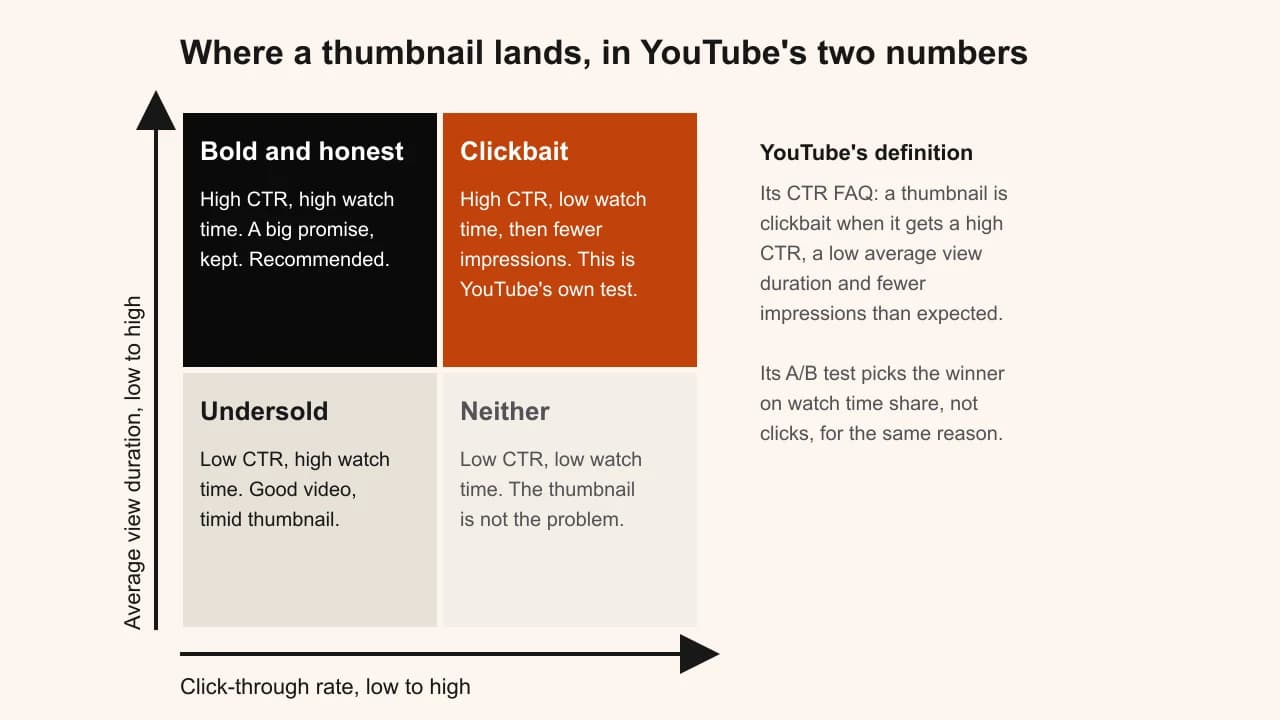
That is the trap. The clickbait corner has the highest CTR of the four, so a creator who reads only CTR will keep making the thumbnail that is quietly cutting their reach. The corner to aim for is high CTR and high watch time: the promise was big, the video kept it. The corner most honest channels sit in is the other one, high watch time and low CTR: the video is good and the thumbnail undersells it, which is the only case where "make it bolder" is the right advice.
What does YouTube's policy actually punish?
YouTube punishes the gap between the promise and the video, through two separate policies: the thumbnails policy removes a misleading image, and the spam policy treats "malicious clickbait" as grounds for strikes and suspended monetisation. It helps to keep the two apart.
The thumbnails policy is about the image itself. It lists what a thumbnail may not show (pornography, gore, vulgar text, imagery meant to shock) and, in the same list, "a thumbnail that misleads viewers to think they're about to view something that's not in the video". A violating thumbnail is removed; a first offence is usually a warning, repeats within 90 days can become a strike, and three strikes in 90 days can end the channel under YouTube's strikes system.
The spam policy is about behaviour. Its list of examples includes "malicious clickbait: using maliciously misleading titles, thumbnails, descriptions, or imagery to trick users into clicking on a video that does not deliver what was promised", with YouTube's own example of a title offering a full sports match on a video that shows a clip. The CTR FAQ's advice to avoid clickbait links the word to this page, so the metric and the policy describe the same thing. The penalties on that page go further than a removed image: suspended monetisation, strikes, termination.
Neither page punishes exaggeration, emotion or big text. What both punish is the gap between the promise and the video. A thumbnail you would be embarrassed to defend to a viewer who just watched the whole video is the one to worry about.
Is clickbait illegal?
No. Click baiting is not illegal in itself; there is no law against a misleading thumbnail. It is a platform rule, enforced by YouTube through recommendations, monetisation and strikes, and the recommendation side is the part creators feel first, long before any policy review. It becomes a legal matter when the video is also deceptive advertising. In the United States, the FTC's endorsement guides rest on Section 5 of the FTC Act, which prohibits deceptive advertising, and they apply to a video that promotes a product whatever its thumbnail says. A thumbnail that impersonates a real person or company, or fronts a scam, falls under other YouTube policies before it falls under any law.
Why do clickbait thumbnails still get used?
Because the first number they move is the one creators look at first. A misleading thumbnail will raise click-through rate on the day it goes up, and if nobody reads average view duration on the same video, the lesson learned is the wrong one. YouTube's own thumbnail and title tips say the same of titles, and the mechanism is identical: "Be accurate. Make sure your title accurately represents the video. If not, viewers may stop watching, which can impact discoverability." The short-term gain is real. So is the slow loss of the audience that clicked once and learned not to click again.
How do I make a thumbnail bold without clickbait?
People searching for how to make clickbait thumbnails usually want the click rate without the penalty. The way to get it is to make the biggest promise the video actually keeps, legibly: one subject, an emotion the footage earns, five words or fewer, and a claim a viewer can check early in the video. Three habits do most of the work.
Write the promise from the video, not for it. Start with what happens in the video and find the strongest true sentence about it. "I found the rarest diamond" is a thumbnail if the diamond is in the footage. If the strongest true sentence is dull, the problem is the video, and a thumbnail cannot fix that without lying. A generator that writes its brief from the video's own title, as ThumbnailMaker does when you paste the link, starts from the right side of that line by construction; it still cannot know what you did not film.
Use emotion that the video earns. A shocked face is honest on a video with a shock in it. The rules in how to make a thumbnail that gets clicks hold either way: one subject, strong contrast, five words or fewer, nothing under the duration badge.
Let the test decide, on watch time. YouTube's own A/B test, the A/B Testing button under Thumbnail in Studio on a computer, picks the winner among up to three thumbnails on watch time share, not clicks. Its page gives the reason: tests are optimised "for overall watch time over other metrics, like click-through-rate", so that viewers "don't waste their time clicking on the wrong videos". A thumbnail that wins clicks and loses watch time does not win the test. Three honest versions of the same promise is the cleanest experiment you can run; the three-concept pack in ThumbnailMaker makes them from one link, on the emotion, the object and a contrast. The custom thumbnail guide covers where the button is and what each result means.

Can I tell before publishing whether a thumbnail is clickbait?
Partly. You can check that it reads at feed size, that the subject is the one the video is about, and that the text does not say more than the video does; the free thumbnail tester handles the first two and shows the image next to its title in a mock feed, which is where a mismatch between the words and the picture is easiest to see. The last part, whether viewers stay, only the video can answer. Read the result the way YouTube does: after the first week, average view duration next to CTR on the same video, against your own channel's other videos. What a good CTR looks like gives the numbers and the places to read them.
Is a high CTR a bad sign, then?
No. A high CTR with a high average view duration is the best outcome on the platform: a big promise, kept. The clickbait signal needs both halves, a high click rate and a short stay, followed by a fall in impressions. So read the two numbers together. YouTube says half of all channels sit between 2% and 10% CTR, but the comparison that matters is your own channel's usual: CTR above it with watch time holding means the thumbnail did its job. CTR up and watch time down on the same video means the thumbnail promised something the video did not have, and the fix is the thumbnail or the video, never a louder thumbnail.
Aymane Senhaji — Building ThumbnailMaker after generating and grading thousands of AI thumbnails by hand. Writes about thumbnail design, CTR, and what's actually happening under the hood of an AI generator.