What Is a Good CTR on YouTube? Real Benchmarks (2-10%)
By ThumbnailMaker Team · · Updated · 8 min read
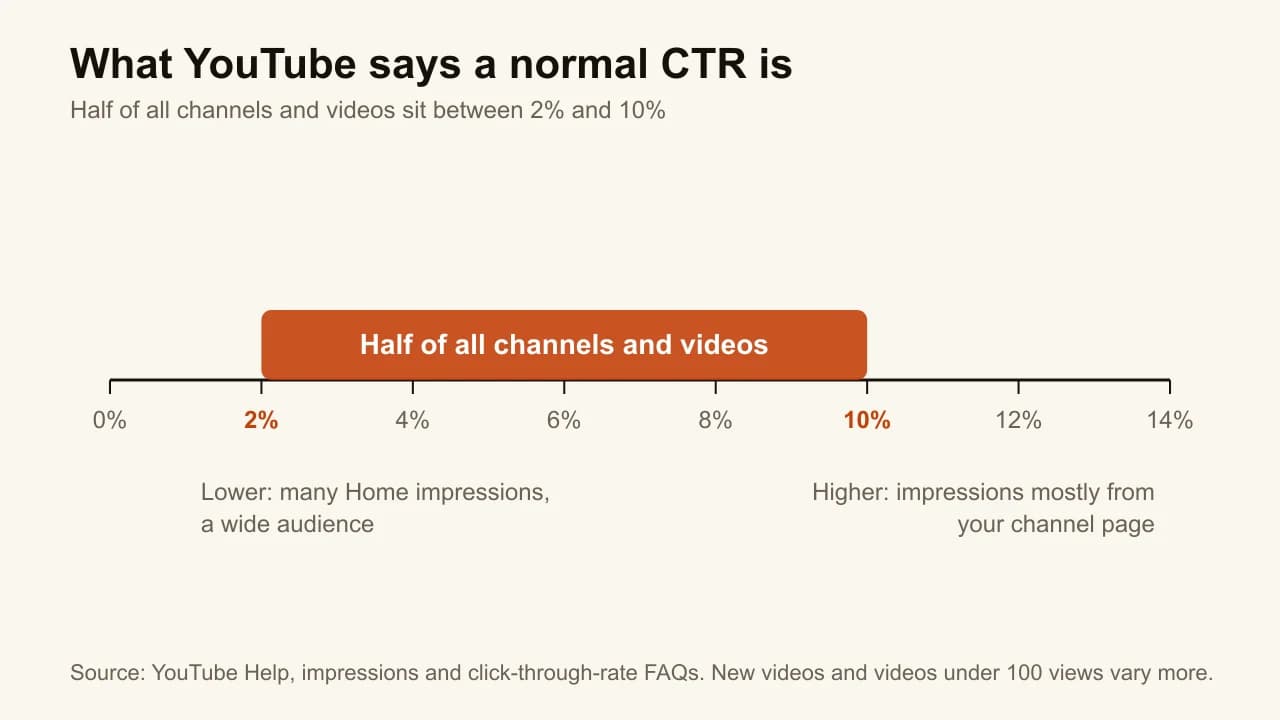
Quick answer: a good CTR on YouTube sits inside the 2% to 10% band that YouTube's own Help page gives for half of all channels and videos. Inside that band, this post's reading is that 4-6% is solid for most channels, above 6% is good, and above 10% usually means the packaging, thumbnail plus title, is doing real work rather than riding an existing audience. The comparison that tells you anything is against your own channel over time, not against someone else's number: CTR moves with subscriber count, traffic source and how cold the audience is, so two channels at 5% can be in completely different health. And a rising CTR on its own is not the win it looks like. If click-through climbs while average view duration falls on the same videos, that is what YouTube reads as clickbait. The goal is a thumbnail clicked by people who actually wanted the video, not the highest possible rate.
What is impressions click-through rate?
Impressions click-through rate is the share of the thumbnails YouTube showed that turned into a view. YouTube counts an impression when your thumbnail is shown for more than one second with at least half of it on screen, on YouTube's own surfaces (home, search, the suggested column, the subscriptions and other feeds, playlists); the definition and the list of what does not count are on YouTube's impressions page. Impressions on external websites, in embeds, in end screens and in notifications are not counted, so views from a blog or a tweet do not lower your rate, and that is also why views divided by impressions never matches the CTR Studio shows, as the CTR FAQ explains.
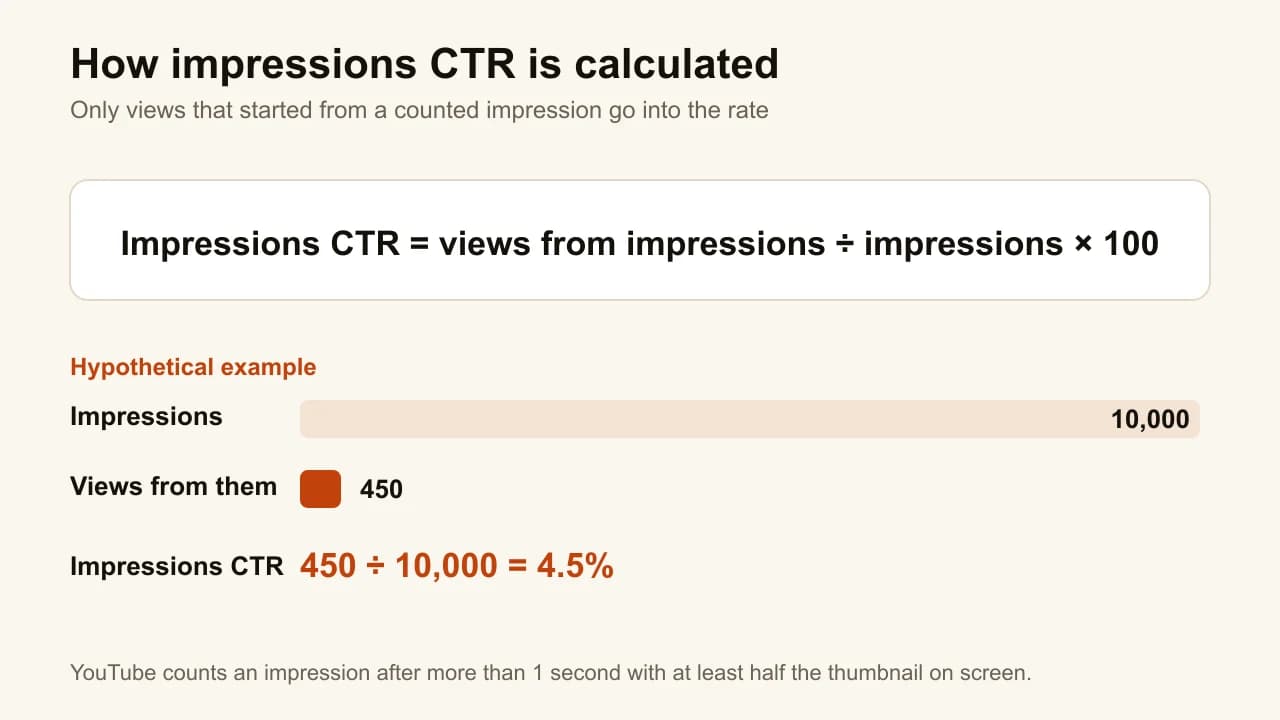
You read it in YouTube Studio under Analytics, in the Reach tab, for the channel or for one video. For packaging decisions, YouTube's own thumbnail and title tips suggest two cuts: CTR on Home and Suggested in the first 24 hours for a general audience, and CTR in the Subscriptions feed in the first 24 hours for your subscribers.
What's a good YouTube CTR?
The only published benchmark is YouTube's: half of all channels and videos sit between 2% and 10%. Everything finer than that is interpretation, so the table says whose number each row is.
| CTR | Whose figure | What it usually means |
|---|---|---|
| 2% to 10% | YouTube, half of all channels and videos | The normal range |
| Under 100 views, or a channel under a week old | YouTube: "wider range" | Too early to read |
| High-impression video (pushed on Home) | YouTube: "naturally lower" | A lower rate can still be healthy |
| Channel page, subscriptions feed | YouTube: "higher" | A warm audience inflates the rate |
| 4% to 6% | This post's reading | A reasonable target for most channels |
| Above 6% | This post's reading | Good packaging, or a loyal audience |
| Above 10% | This post's reading | Rare; check watch time before celebrating |
The number that matters is your own channel's trend over time, not a single global average. CTR is an average of very different traffic sources, and which ones make up most of your impressions changes what a "good" number looks like for you specifically. Check the traffic source breakdown in Studio before comparing yourself to any benchmark, including this one.
Is a 4% CTR good on YouTube?
Yes, for most channels. 4% sits inside the 2-10% range that YouTube's Help page gives for half of all channels and videos, and inside the 4-6% band this post treats as a reasonable target. Two things change how to read it. A video getting a lot of impressions, such as one the home page is pushing, naturally has a lower CTR, so 4% there can be healthier than 8% on a video shown mostly to subscribers. And YouTube says new videos, and videos under 100 views, swing across an even wider range. Judge the number after the first week, against your own channel's other videos.
Why is my YouTube CTR low?
Three causes account for most of it. First, the thumbnail and title aren't giving a scrolling viewer a clear reason to click in the half-second they spend deciding: a cluttered frame with three competing focal points loses to one clear one, every time (the free thumbnail tester shows yours at the 168-pixel suggested size, which is where clutter dies, and the free thumbnail rater grades a live video's thumbnail from 1 to 5 with the fixes in order). Second, the video is being shown to a colder audience than usual: YouTube's FAQ says videos with a large number of impressions, the ones Home is pushing, naturally have a lower CTR, and that is a distribution shift, not a packaging failure. Third, small sample size: YouTube notes that videos under 100 views, or channels less than a week old, sit outside the normal range entirely. A video with under 100 total views can swing 5 points in either direction on CTR alone and tell you almost nothing reliable yet.
Does CTR vary by traffic source?
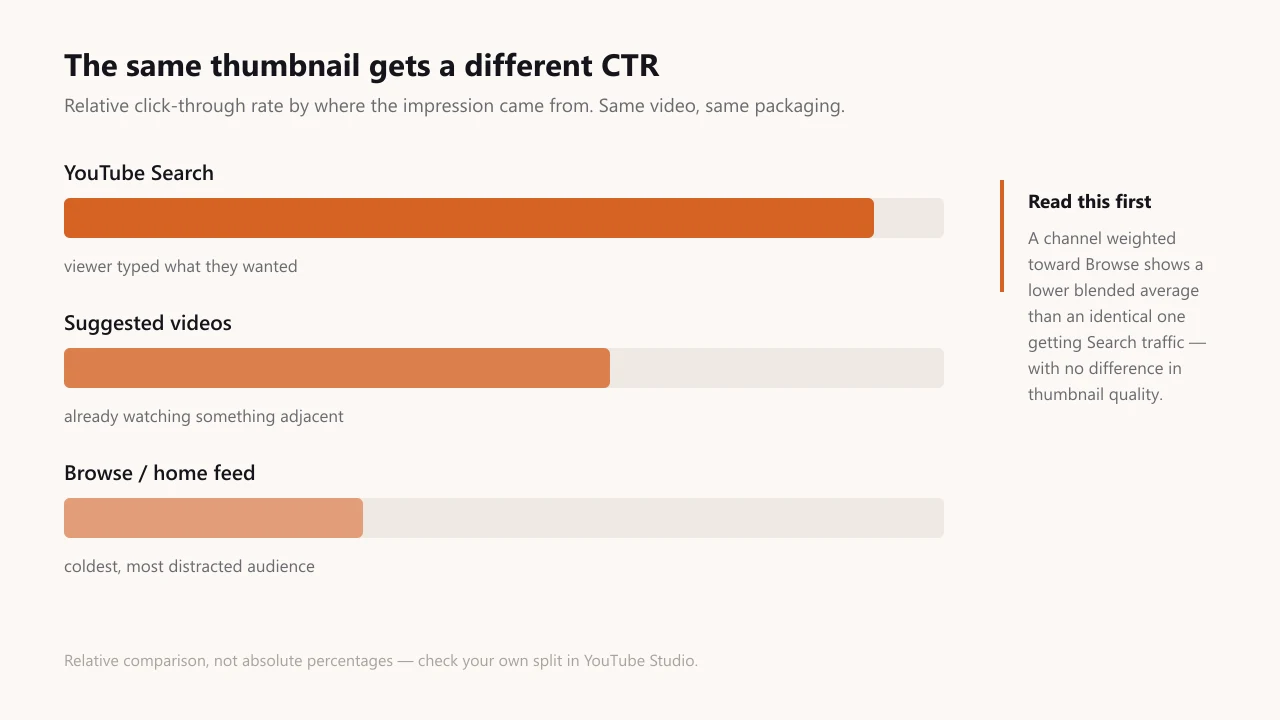
Yes, and this is the single biggest reason a flat "good CTR" number is misleading. YouTube's FAQ gives the two ends: videos whose impressions come mostly from sources like your channel page, where the viewer already chose you, "may have a higher rate"; videos that get a lot of impressions, such as on the Home page, naturally have a lower one. YouTube does not publish where Search falls, and this post does not guess; the viewer typed something close to your title, which is a warmer start than Home and a colder one than your own channel page. A channel whose impressions lean heavily toward Home will show a lower blended average than an identical channel getting more channel-page traffic, with no difference in thumbnail quality at all. That is why the thumbnail and title tips page tells you to read Home and Suggested separately from the Subscriptions feed, which it calls your most engaged fans.
Does channel size affect CTR?
Generally, yes. Smaller channels tend to post higher CTR, not because their content is better, but because their impressions are concentrated among an already-engaged audience that is more likely to click; YouTube's FAQ describes exactly this, a narrower and more loyal audience producing a higher rate. As a channel grows, YouTube starts surfacing it to broader, colder audiences it hasn't earned trust with yet, so the blended CTR naturally settles lower even as total views keep climbing. A dropping CTR alongside rising views is often just this dynamic playing out, not a sign that thumbnails got worse.
How do I improve my YouTube CTR?
Fix the packaging, not the video: one focal point instead of a collage, five words of text or fewer, a frame composed for 16:9 rather than cropped into it. The full breakdown, with the reasons behind each rule, is in how to make a YouTube thumbnail that gets clicks. None of it is about tricking anyone into a click; it is about making the one true thing about the video legible in under a second.
Should I A/B test thumbnails instead of reading CTR?
For any video that matters, yes, because YouTube's own test does not decide on CTR at all. In YouTube Studio on a computer, under Thumbnail, the button is called A/B Testing; you upload up to three thumbnails, YouTube shows them to viewers at the same time, and after a few days, or up to two weeks, the one with the highest watch time share wins. YouTube's page on the feature explains why watch time and not clicks: a thumbnail that wins clicks but loses watch time is the clickbait case from the first paragraph, and the test is built to reject it. Two practical rules from the same page: variants that are too similar run longer or end "inconclusive", and every variant must be at least 1280 × 720 or all of them are downscaled to 480p. Third-party tools test thumbnails too; the YouTube thumbnail testers compared here differ mainly in whether they measure real viewers or only preview the image.

The hard part is having three genuinely different thumbnails to test. That is what the three-concept pack in ThumbnailMaker's AI thumbnail maker is for: one click makes three takes on the same video from three angles, the emotion, the object and a contrast, sized for the test. Plans start at $12 a month.
Is a higher CTR always better?
No. A high CTR paired with low average view duration is exactly the signal YouTube reads as clickbait, and its FAQ says such videos get recommended less afterward despite the strong initial click rate. The goal isn't the highest possible CTR, it's a thumbnail that gets clicked by the people who'll actually want the video they clicked into. Optimizing CTR in isolation, without checking retention on the same videos, is optimizing the wrong number.
ThumbnailMaker Team — Guides from the people building ThumbnailMaker: thumbnail design, CTR, and what happens under the hood of an AI generator. Every number is checked against YouTube's own pages and dated.
Try it on your next video
Paste the video's link: the brief is written for you, then you generate with a plan from $12 a month.